Hepatobiliary and Pancreatic Surgery (HPB)
Liver, Bile Duct and Pancreas Disease
Mount Sinai South Nassau's Liver, Bile Duct and Pancreas Surgery Program, or HPB surgery program, headed by Ganesh Gunasekaran, MD, routinely treats patients with complex benign tumors, malignant cancers and other disorders of the liver, gallbladder, bile duct and pancreas, including pancreatic cancer.
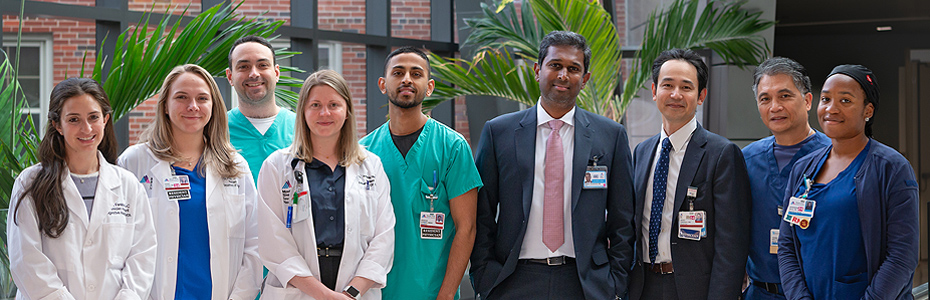
The program’s experienced, board certified and fellowship-trained HPB surgeons use the latest technology and minimally invasive techniques and work in conjunction with other specialists such as advanced gastroenterologists (GI physicians) to provide patients with a multidisciplinary approach to care.
For more information about our program, please call 516-374-8699.
Conditions We Treat
- Bile Duct Cancer (Cholangiocarcinoma)
- Gallbladder Cancer
- Liver Cancer (Hepatocellular Carcinoma)
- Metastatic Liver Tumors (Colorectal Cancer)
- Benign Liver Tumors
- Pancreatic Cancer
- Acute pancreatitis
- Chronic pancreatitis
- Pancreatic cysts
- Pancreatic Neuroendocrine Tumors (PNET)
Procedures for Liver and Bile Duct Tumors
- Liver Resection
A liver resection, or hepatectomy, is a surgical procedure to remove part of your liver. You can have up to two-thirds of your liver removed if the rest of your liver is healthy. If you have liver disease, you may have a smaller portion removed. Your liver can grow back and if your remaining liver is healthy, it will grow back to its former size.
- Minimally Invasive Liver Surgery
Minimally invasive surgery are procedures done with small incisions (cuts). This method reduces side effects and helps you recover faster. There are minimally invasive procedures for primary liver cancer, such as ablation, NanoKnife®, or embolization.
- Bile Duct Resection, including Cholecystectomy
Bile duct resection is surgery that removes your gall bladder and bile duct outside the liver. Your surgeon then reconnects your liver and intestine. After this surgery, bile will be able to flow freely from your liver into your intestine to help you digest food.
- Hepatic Artery Infusion Pump
Hepatic Artery Infusion is a type of regional chemotherapy to treat advanced colorectal cancer that has spread to the liver. It delivers a high dose of chemo directly into the liver's blood supply using a pump that surgeons implant under your skin.
- Ablation (Laparoscopic or Percutaneous Approach)
Ablation is treatment that destroys liver tumors without removing them. These techniques can be used in patients with a few small tumors and when surgery is not a good option (often because of poor health or reduced liver function).
Procedures for Pancreatic Tumors
- Distal Pancreatectomy
A distal pancreatectomy is a minimally invasive pancreatic cancer treatment where your doctor removes the body and tail of the pancreas.
- Whipple Procedure (Pancreatoduodenectomy)
This operation removes tumors on the top of the pancreas, the lower portion of the bile duct and the ampulla of Vater. Also known as pancreaticoduodenectomy, the procedure can be performed robotically or laparoscopically.
- Pancreatic Enucleation
Enucleation of pancreatic tumors is a less extensive surgical technique in which certain types of low-grade or benign pancreatic tumors are removed with a minimal margin of the healthy pancreatic tissue, thus preserving maximum healthy tissue for optimal functioning.
- Minimally Invasive Pancreatic Surgery
Laparoscopic surgery allows the surgeon to access the abdomen via several small "keyhole" incisions (less than one centimeter each). Many patients with pancreatic cysts that require surgery are candidates for this approach, which offers smaller incisions, shorter hospitalization (typically 2 days), less pain, and a faster return to work and life.
Grateful Patient and Grandfather of Five Thomas Shanley
Meet Our Team

Ganesh Gunasekaran, MD
Director, Hepato-Pancreato-Biliary (HPB) Service
Dr. Ganesh Gunasekaran is an internationally renowned hepatobiliary and pancreatic surgeon and Chief of Hepatobiliary Surgery at the Mount Sinai Health System. Having performed more than 1,000 hepatobiliary and pancreatic operations, he is recognized for his expertise in complex liver and pancreatic resections, advanced minimally invasive surgery, and hepatobiliary malignancies. He is a trusted referral surgeon for some of the most technically challenging cases in the specialty.
Dr. Ganesh Gunasekaran joined Mount Sinai in 2014 and has led the growth of a comprehensive hepatobiliary surgery program across the Health System. He has been building the hepatobiliary program at Mount Sinai South Nassau since 2017, developing multidisciplinary liver, bile duct, and pancreatic services that bring advanced surgical care to patients across Long Island. A major milestone was the hospital's designation as a National Pancreas Foundation Pancreatic Cancer Center of Excellence, placing it among a select group of nationally recognized institutions.
With extensive experience in liver transplantation and complex oncologic surgery, Dr. Gunasekaran treats the full range of hepatobiliary and pancreatic conditions. His research has been published in leading journals, including Annals of Surgery and The Lancet, and he established the Hepatobiliary Surgery Research Fellowship at the Icahn School of Medicine at Mount Sinai. A dedicated educator and internationally invited speaker, he has trained surgeons who now lead hepatobiliary programs across the United States and abroad.
Dr. Gunasekaran earned his medical degree from Madras Medical College, completed his general surgery residency at Montefiore Medical Center, and pursued fellowship training in multi-organ transplantation and hepatobiliary surgery at the Cleveland Clinic.

James O. Park, MD, FACS
System Chief, Division of Surgical Oncology, Department of Surgery
James O. Park, MD, FACS is a board certified hepato-pancreato-biliary (HPB) surgical oncologist specializing in diseases of the liver, gallbladder, bile duct, pancreas, and upper gastrointestinal tract. He is Professor of Surgery at the Icahn School of Medicine and Chief of Surgical Oncology for the Mount Sinai Health System.
His clinical focus is on minimally invasive surgery for complex hepatobiliary and pancreatic malignancies, with extensive robotic surgery expertise, as well as experience in Whipple procedure, liver resection and Hepatic Arterial Infusion Pump placement robotically. He performed the first robotic liver resection in the Pacific Northwest (2011) and the first robotic Whipple procedure in Washington state (2012). He founded the University of Washington Robotic HPB Surgery Program, chaired Fred Hutch at UW Medical Center’s robotic surgery program, and led its designation as a Center of Excellence.
He also specializes in Histotripsy, which is a noninvasive, FDA-approved procedure using focused ultrasound pulses to break down tumor cells without incisions. Guided by real-time imaging, it preserves healthy tissue, enables rapid recovery, and shows excellent outcomes for patients with small, localized liver tumors.
Dr. Park earned his Bachelor of Science degree in Biochemistry from Brown University and a Doctor of Medicine degree from the Perelman School of Medicine at the University of Pennsylvania. He completed general surgery residency and research fellowship at the Pritzker School of Medicine at the University of Chicago and further specialized in Complex General Surgical Oncology at Memorial Sloan-Kettering Cancer Center.
- Interventional GI Team
- Pruthvi Patel, MD
- Jamie Fenster, PA-C
- Medical Oncology Team
- Radiation Oncology Team
- Interventional Radiology Team
Contact
To contact us, or for more information about the Hepatobiliary and Pancreatic Surgery Program, please email longislandhpb@mountsinai.org, or call 516-374-8699.
Hepatobiliary and Pancreatic Surgery
Mount Sinai Doctors - Five Towns
1436 Broadway
Hewlett, NY 11557
Mount Sinai-Wantagh
2020 Wantagh Avenue
Wantagh, NY 11793
516-961-4545


Learn More
Hepatobiliary and Pancreatic Surgery (HPB)
Interventional Endoscopy & General GI
Gastrointestinal (GI) Endoscopy Unit
Cancer Treatment & Oncology Care